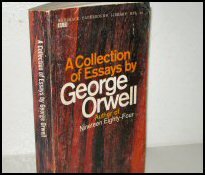
George Orwell is a name familiar to Indians.
Besides his prowess as an author, he was after all an Anglo-Indian, born in Motihari, Bihar as Eric Blair (George Orwell was actually his pen name).
Some of Orwell’s books like Animal Farm and 1984 have also found favor with the English-speaking literatti in India.
Much as we love Animal Farm, Burmese Days, 1984 and other Orwell works, one of our favorites remain his 1936 essay Shooting an Elephant.
Set in Moulmein, Lower Burma, where Orwell was a police officer, the essay beautifully describes how the imperialists were driven by the natives’ expectations to explain why he shot an elephant.
Although the elephant had turned violent and killed a Tamil Coolie earlier in the day, it had subsequently quietened down and was calmly eating grass when Orwell came across the pachyderm a few yards from the road.
Like the placid elephant, Orwell calmly ponder the situation and the elephantine problem he is confronted with, literally and figuratively.
To kill the elephant would be murder; but to walk away would be worse because he would become the object of ridicule and laughter from the side of the natives.
And suddenly I realized I should have to shoot the elephant after all. The people expected it of me and I had got to do it. And it was at this moment, as I stood there with the rifle in my hands, that I grasped the hollowness, the futility of the White man’s dominion in the East.
Orwell casts the White imperialists in the role of puppets marching to the tune of the natives expectations, of trying to impress them and appearing resolute.
Here was I, the White man with his gun, standing in front of the unarmed native crowd - seemingly the leading actor of the piece; but in reality I was only an absurd puppet pushed to and fro by the reality of the yellow faces behind.
Conscious of the few thousand natives standing behind him and watching him, Orwell becomes determined to act “like a Sahib” and murders the poor elephant.
For that’s what it is. Plain and simple. And Orwell candidly acknowledges that he did it to avoid looking like a fool before the natives.- Copyright SearchIndia.com.
|