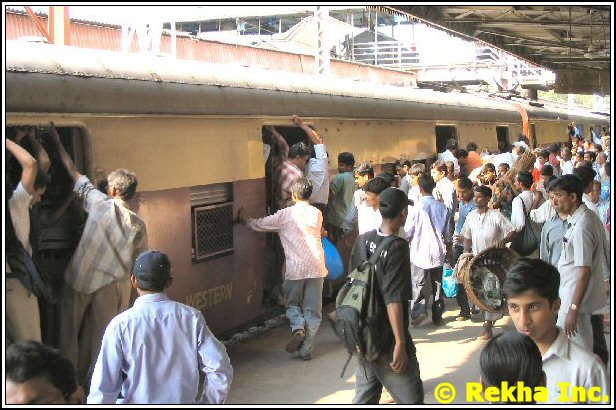
 Crowded Mumbai Train Crowded Mumbai Train
(Photo - November 2004)
Local trains are the lifeline of Mumbai, the commercial capital of India.
The Mumbai local train system is spread over 302 route kilometers.
An estimated 6.4 million commuters living in the far-flung suburbs of Mumbai use the local trains daily to travel to their workplace.
Riding in crowded Mumbai trains is not for the faint of heart.
For the timid, getting into and off a Mumbai train is close to a life altering experience. Engulfed in a sea of humanity, the hapless commuter just flows with the tide.
The above Photo (taken in 2004) illustrates how crowded and dangerous Mumbai trains can be.
In 2006, 3,404 people were killed involving Mumbai trains, according to the Wall Street Journal. Those killed were commuters on the trains, crossing the tracks or slipped off the platform while boarding or getting off extremely crowded trains.
"Accidents are so common that stations stock sheets to cover corpses," Eric Bellman wrote in the Wall Street Journal. In New York state, 127 people are estimated to have been killed in the last five years in train related incidents.
The Journal estimated that the Mumbai commuter network's rail tracks carry 20,000 passengers every day for each kilometer, or 0.62 mile, of rail, surpassing Tokyo where the comparable number is 15,000 people per kilometer.
During peak hours in Mumbai, 550 people travel in a carriage built for 200. We doubt if the cattle cars used to transport poor Jews to concentration camps in Poland and Germany were as crowded.
To make matters worse, hundreds of thousands of Mumbai's poor people live in shanties abutting the railroad tracks.
Mumbai's horrific deaths involving commuter trains is just one more example of the failure of the Indian state to build a basic infrastructure for its people.
Sources:
Mumbai Railway Vikas Corporation
Wall Street Journal, April 19, 2007
|

